When is Quebec’s next election?
The law sets the next general election for Monday, October 7, 2030. But with 60 of 127 seats, the Parti Québécois government is a minority, and a vote could come much sooner.
The scheduled date: October 7, 2030
Since 2013, Quebec’s Election Act has set the date of general elections. Voting takes place on the first Monday of October in the fourth calendar year after the end of the previous legislature. The law also makes each legislature expire on August 29 of that fourth year.[1]
The legislature elected in 2022 ended in 2026. The fourth year after that is 2030, and its first Monday in October falls on the 7th. The same rule produced the elections of October 1, 2018, October 3, 2022 and October 5, 2026.
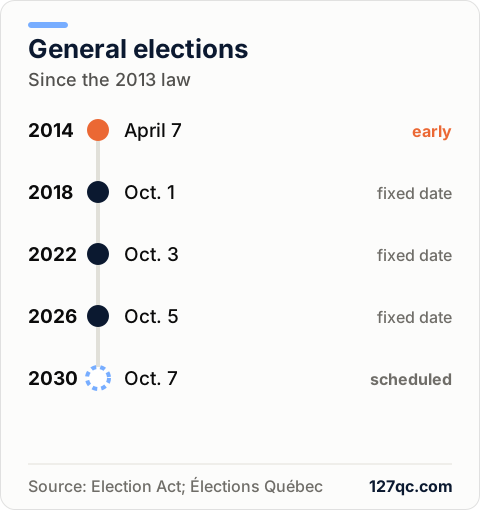
The law allows two adjustments. If the election period would overlap with a federal or municipal election, the vote would move to the first Monday of April of the following year, which would mean April 2031. And in the event of a disaster or another serious, unforeseeable situation, the Chief Electoral Officer can postpone voting by one week.[1]
A fixed date, not a guaranteed one
The 2013 law states that it does not affect the lieutenant governor’s power to dissolve the Assembly before the legislature expires.[1] In practice, an election can therefore be called earlier.
That happened in the very first legislature covered by the new rule. Elected as a minority in September 2012 with 54 members, Pauline Marois’s government called an election on March 5, 2014, for a vote on April 7. The scheduled date at the time was October 3, 2016.[2]
Two paths to an early election
The government loses the confidence of the Assembly. Under the Standing Orders of the National Assembly, confidence can be at stake only in certain votes: a motion of censure (non-confidence), the motion approving the government’s general policy after the opening speech, the motion approving its budget policy, the passage of a supply bill, or a motion on which the government has expressly staked its responsibility. Opposition parties may move up to seven motions of censure per session.[3]
The premier picks the moment. A minority government can seek a dissolution if it believes it can win a majority. Jean Charest did so in 2008 without having been defeated in the Assembly: his Liberal government, a minority since 2007, won a majority on December 8, 2008.[4]
What the 2026 numbers say
On October 5, 2026, the Parti Québécois won 60 seats, ahead of the Quebec Liberal Party (39), the Conservative Party of Quebec (19) and Québec solidaire (9). The Coalition Avenir Québec won no seats. A majority is 64 seats. Paul St-Pierre Plamondon became premier on October 21, 2026, with a cabinet of 23.[5]
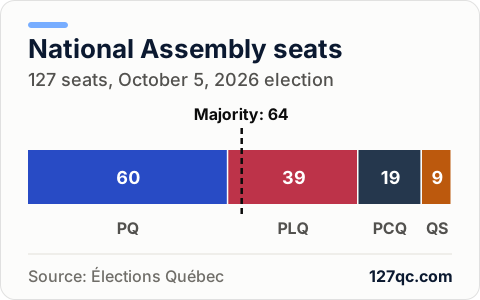
A simple calculation shows that the Liberals and Conservatives together, with 58 seats, do not have enough votes to defeat the government on their own. All three opposition parties would have to vote together. We go through the numbers in Minority government: who could bring down the PQ?
What history shows
Quebec has had three minority governments before this one. None lasted two years:
- 1878–1879: Henri-Gustave Joly de Lotbinière’s Liberals governed with the support of two independent Conservatives; defections brought them down in 1879, without a new election.[6]
- 2007–2008: Jean Charest’s Liberal government, elected on March 26, 2007, called an election itself, held on December 8, 2008.[4][7]
- 2012–2014: Pauline Marois’s PQ government, elected on September 4, 2012, called an election, held on April 7, 2014.[2]
These precedents do not tell us what will happen before 2030. They only show that in Quebec, minority governments have more often ended by the premier’s decision than by a lost vote in the Assembly.
What it means for voters
An election can be called with only a few weeks’ notice. To find out which riding you will vote in, use 127QC’s postal code search: find my riding. You will also find the member elected in 2026 and your riding’s results.
127QC will resume tracking the polls and projecting seats as soon as an election, general or by-election, is on the horizon.
Sources
- An Act to amend the Election Act for the purpose of establishing fixed-date elections (French text), S.Q. 2013, chapter 13, assented to June 14, 2013: sections 129, 129.1, 129.2 and 490 of the Election Act, and the length of a legislature in the Act respecting the National Assembly. Accessed October 22, 2026.
- Wikipedia, Élections générales québécoises de 2014 (in French). Dissolution on March 5, 2014, vote on April 7, 2014, scheduled date October 3, 2016. Accessed October 22, 2026.
- Assemblée parlementaire de la Francophonie, Recueil des procédures parlementaires: Québec, chapter 8 (in French), based on the Standing Orders of the National Assembly, sections 303.1 and 304. Accessed October 22, 2026.
- Wikipedia, Élections générales québécoises de 2008 (in French). Dissolution on November 5, 2008, vote on December 8, 2008, with no confidence vote lost. Accessed October 22, 2026.
- Le Droit (October 21, 2026), Voici les ministres du gouvernement du Parti québécois (in French). Results in all 127 ridings: Élections Québec, see the elected members on 127QC.
- Wikipedia, Élections générales québécoises de 1878 (in French). Accessed October 22, 2026.
- Wikipedia, 2007 Quebec general election. Liberals 48 of 125 seats; first minority government since 1878. Accessed October 22, 2026.