Bill 21: A landmark ruling, five political visions for Quebec
The Supreme Court has upheld most of Quebec’s Act respecting the laicity of the State. The ruling ends seven years of litigation in this case and reveals deep political divisions over secularism, the notwithstanding clause, and the balance of power between elected officials and the courts.
Seven years after it was enacted, Quebec’s Act respecting the laicity of the State has passed its biggest judicial test. On Friday, November 27, 2026, the Supreme Court of Canada upheld almost all of Bill 21. [1]
The ruling also confirms that Quebec and other provinces can invoke the notwithstanding clause pre-emptively. Courts retain the power to consider whether a law is consistent with charter rights even when an override applies. [1]
That last conclusion shaped the reactions in the hours after the ruling. Some saw it as a confirmation of Quebec’s autonomy. Others saw it as a setback for elected legislators. Rights organizations had a mixed response to a ruling that preserves both restrictions they oppose and a form of judicial scrutiny. [6] [10]
1. Bill 21: Seven years of debate
Enacted on June 16, 2019, under François Legault’s government, the Act respecting the laicity of the State rests on four principles. [2]
- The separation of state and religions.
- The religious neutrality of the state.
- The equality of all citizens.
- Freedom of conscience and religion.
Its most controversial provision bars certain people in public roles from wearing religious symbols. It covers designated teachers, police officers and certain prosecutors. [2]
Supporters see the law as a continuation of the secularization of Quebec institutions that began during the Quiet Revolution. Opponents say it restricts religious freedom and creates barriers to certain professions, especially for people whose beliefs involve wearing a visible symbol. These views have shaped political and legal debates since 2019. [1] [10]
2. Seven years in the courts
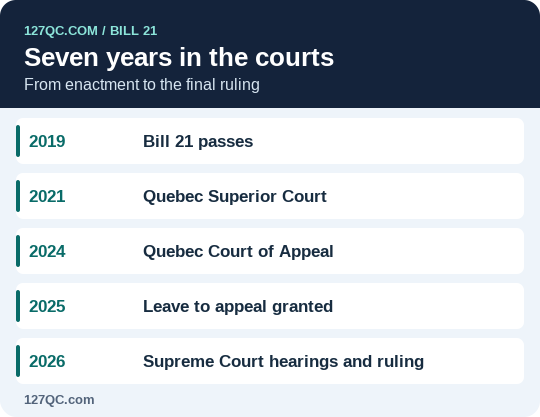
| Date | Event |
|---|---|
| June 2019 | Bill 21 passes |
| April 2021 | Quebec Superior Court judgment |
| February 2024 | Quebec Court of Appeal judgment |
| 2024 | Canadian Charter override renewed |
| January 2025 | Supreme Court grants leave to appeal |
| March 2026 | Supreme Court hearings |
| November 2026 | Supreme Court ruling |
The challenge raised constitutional questions about freedom of religion, equality rights, the language rights of Quebec’s English-speaking minority and the limits of the notwithstanding clause. The November 27, 2026 ruling answers these questions. Political debate continues. [1] [3] [5]
3. What the Supreme Court decided
In English Montreal School Board v. Quebec (Attorney General), 2026 SCC 41, the Supreme Court upheld most of Bill 21. [1]
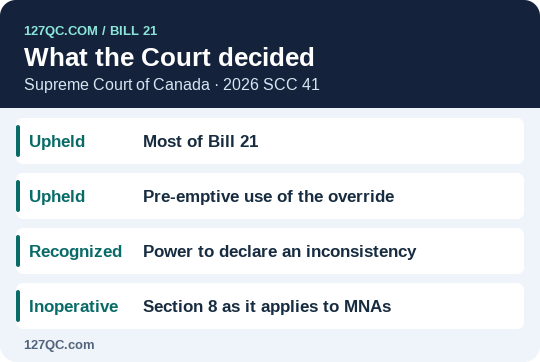
| Issue | Outcome |
|---|---|
| Ban on wearing religious symbols | Upheld |
| Application to English-language school boards | Upheld |
| Pre-emptive use of the notwithstanding clause | Upheld |
| Power to issue a declaration | Recognized |
| Declaration of inconsistency in this case for the rights covered by the overrides | Declined |
| Requirement for MNAs to exercise their functions with their faces uncovered | Inoperative insofar as it applies to MNAs |
The exception for MNAs stems from democratic rights protected by section 3 of the Canadian Charter. The notwithstanding clause cannot override those rights. The ruling upholds most of the Act and illustrates the constitutional limits of the override power. [1] [4]
4. Two charters, two override provisions
Public debate often refers to the notwithstanding clause as a single mechanism. Quebec has two distinct provisions. One is in Quebec’s Charter of human rights and freedoms, adopted in 1975. The other is in the Canadian Charter of Rights and Freedoms, which became part of the Constitution in 1982. [4]
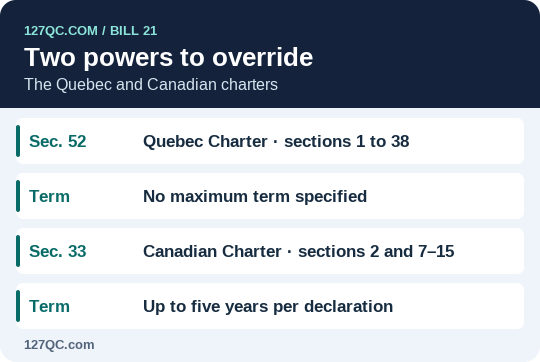
| Feature | Quebec Charter | Canadian Charter |
|---|---|---|
| Adopted | 1975 | 1982 |
| Provision | Section 52 | Section 33 |
| Rights covered | Sections 1 to 38 | Sections 2 and 7 to 15 |
| Maximum term specified | None | Five years |
| Renewal needed to keep override in effect | No | Yes |
Section 33 of the Canadian Charter can override freedom of religion, freedom of expression, certain legal rights and equality rights. Democratic rights, mobility rights and constitutional language rights fall outside its scope. The Supreme Court confirmed that a legislature can invoke it when it enacts a law, before any court ruling. [1] [4]
5. Declarations of inconsistency are at the centre of the debate
Consider a legislature that passes a law protected by the notwithstanding clause. A court can still examine the law and find that a provision infringes a Charter right. The provision may remain in force if a valid override covers it. [1]
This raises two questions. Can the law legally remain in force? Does it comply with the rights it overrides? Supporters of declarations see them as a way to inform the public and hold governments accountable. Opponents say they risk moving debates that belong to elected representatives into the courts. [6] [9]
In the Bill 21 case, four judges held that courts can issue a declaration of inconsistency despite an override. A differently constituted majority declined to grant that remedy in this case for the rights covered by the overrides. [1]
6. One ruling, five political reactions
Parti Québécois — A gain for secularism, a setback for autonomy in the premier’s view
Paul St-Pierre Plamondon welcomed the decision to uphold Bill 21. The premier argued that declarations of inconsistency curtail provincial autonomy and warned that they could be used to challenge laws protecting French. He pointed to Quebec sovereignty as an answer to the constitutional limits he sees in the ruling. He also plans to discuss the issue with his provincial counterparts in Toronto on December 7 and 8. [6]
Quebec Liberal Party — Amend Bill 21
Charles Milliard welcomed the confirmation that the National Assembly can invoke the notwithstanding clause. He wants to restrict the ban on religious symbols to roles that exercise coercive powers, including judicial and police roles. Teachers would no longer be subject to the ban. He has left open the possibility of invoking the clause pre-emptively to protect his version of the law if necessary. [14]
Coalition Avenir Québec — Defending a political legacy
For the CAQ, the ruling upholds most of a law that defined François Legault’s time in office. Interim leader Mathieu Lévesque welcomed both the ruling and the preservation of the override power. He expressed reservations about the courts’ ability to issue declarations of inconsistency. [6] [7]
Conservative Party of Quebec — More systematic use of the notwithstanding clause
Éric Duhaime sees the judgment as confirmation that Quebec can exercise autonomy within Canada. He favours more systematic use of the notwithstanding clause for legislation likely to face Charter challenges and wants to limit declarations concerning such laws. The constitutional scope of any such limit remains unresolved. [6] [15]
Québec solidaire — Exceptional use with safeguards
Québec solidaire expressed disappointment that Bill 21 remains largely in force. Roxane Milot, the party’s critic for education, secularism and justice, argued that religious neutrality should apply to what teachers teach. The party considers some restrictions discriminatory and wants to keep working with civil society groups. [8]
Québec solidaire recognizes the clause as an important tool for Canadian provinces. It wants its use, including pre-emptive use, to remain exceptional, require a strong justification and be subject to legislative safeguards. [8]
7. Comparing the parties’ positions
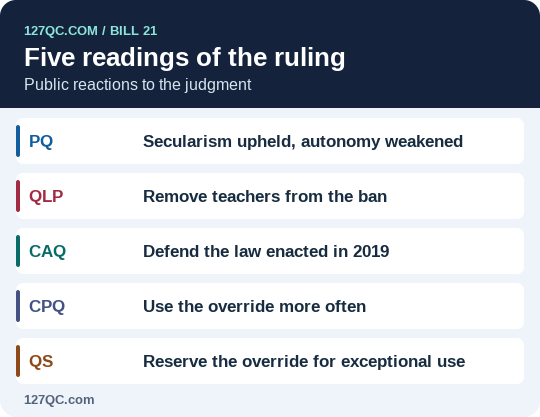
| Party | Position on Bill 21 | Use of the notwithstanding clause | Declarations of inconsistency |
|---|---|---|---|
| PQ | Keep the law | Considering wider use | Critical |
| QLP | Remove teachers from the ban | If necessary | Position to be clarified |
| CAQ | Keep the law | Defends the current mechanism | Reservations |
| CPQ | Supports keeping the law | More systematic use for laws likely to face challenges | Wants to limit them |
| QS | Opposes restrictions it considers discriminatory | Exceptional, with safeguards | Highlights findings of rights infringements in the reasons |
These positions reflect public reactions to the November 27, 2026 ruling. The Liberals and Québec solidaire want to revisit some restrictions and recognize that the override can be used. The PQ, CAQ and Conservatives welcomed the decision to uphold the law and propose different responses to the constitutional limits raised by the judgment. [6] [7] [8]
8. Quebec and Ottawa: Two perspectives
Prime Minister Mark Carney said his government would take time to study the ruling. He stressed the responsibility of governments and legislatures to uphold everyone’s rights and freedoms, including those of minorities. [12]
Federal Justice Minister Sean Fraser emphasized the role of declarations. In his view, allowing courts to identify a rights infringement despite an override contributes to transparency and government accountability. Quebec’s government, the CAQ and the CPQ expressed reservations about the role of the courts in such disputes. [6] [9]
9. Civil society remains divided
Ligue des droits et libertés
The Ligue has called on the National Assembly to set stricter rules for using section 52 of the Quebec Charter. It wants overrides to be temporary, reserved for exceptional circumstances and subject to judicial review. It also wants provisions of Bill 21 it considers contrary to fundamental rights to be removed. [10]
English-language school boards
The Quebec English School Boards Association expressed disappointment and defended school boards’ autonomy in choosing their staff. The issues for the boards include language rights, school governance and religious freedom. [1] [10]
Fédération autonome de l’enseignement
The FAE regretted that Bill 21 remains in force. It welcomed the recognition that courts can find a law inconsistent with rights protected by the charters. [10]
National Council of Canadian Muslims
The council expressed disappointment. CEO Stephen Brown raised concerns about the effective protection of fundamental rights and the social divisions he fears the law may deepen. [11] [13]
10. Legal validity and compliance with rights
Four of the seven judges found infringements of certain protected rights in their respective reasons. A law can remain valid and enforceable through a constitutionally authorized override even when some of its provisions infringe charter rights. This distinction explains some of the diverging reactions to the ruling. [1]
11. Is there a consensus on secularism in Quebec?
There are several questions within the public debate. Do people support separating state and religions? Banning religious symbols for police officers and judges? Extending the same ban to teachers? Invoking the notwithstanding clause? Allowing courts to identify rights infringements?
A person can answer some of those questions differently from others. Interpreting polls requires checking the exact wording, the population surveyed and the dates of fieldwork. Majority support for secularism in principle or a political majority in the National Assembly gives only a partial picture of support for specific measures.
12. A ruling with implications beyond Quebec
The Supreme Court ruled on a Quebec law. Its findings on the notwithstanding clause apply within the Canadian constitutional framework. The other provinces and the federal Parliament can also use section 33. The ruling could inform future debates in areas such as education, labour relations and language policy. It also addresses how Canada balances the authority of elected representatives with constitutional protection for individual rights. [1] [4]
13. The next milestone: 2029
In 2024, the National Assembly renewed Bill 21’s Canadian Charter override. Under the current legislation, it will expire in 2029. The National Assembly will have to decide whether to renew it. That deadline gives parties another opportunity to clarify their positions on secularism, fundamental rights and use of the notwithstanding clause. [4] [5]
Conclusion — The litigation ends and the democratic debate continues
Seven years after its enactment, most of Bill 21 remains in force. The Supreme Court confirmed Quebec’s power to use the notwithstanding clause pre-emptively and recognized that courts can examine whether laws are consistent with charter rights. [1]
The PQ points to limits within Canadian federalism. The Liberals want to change the law’s scope. The CAQ defends its legislative legacy. The Conservatives propose using the override more systematically, while Québec solidaire wants it reserved for exceptional cases with safeguards. Beyond secularism, elected officials and the public will continue debating how to reconcile majority choices, minority rights and the constitutional responsibilities of the courts. [6] [7] [8]
Frequently asked questions
Did the Supreme Court uphold all of Bill 21?
The Court upheld most of it. The requirement for MNAs to exercise their functions with their faces uncovered is inoperative as it applies to them. [1]
Can teachers now wear religious symbols?
The ruling leaves existing restrictions in place for teachers covered by the law, subject to applicable grandfathering provisions. [1] [2]
Can a court strike down a law protected by the notwithstanding clause?
A court can intervene if the law infringes constitutional provisions that cannot be overridden. It can also find an inconsistency with protected rights even when a valid override allows the law to remain in force. [1] [4]
Can the government change Bill 21 after the ruling?
The National Assembly retains the power to amend or repeal the Act.
When will the notwithstanding clause need to be renewed?
Bill 21’s Canadian Charter override is due to expire in 2029 under the current legislation. [5]
127QC — Understanding Quebec politics through facts, data and analysis.
Sources
- Supreme Court of Canada — English Montreal School Board v. Quebec (Attorney General), 2026 SCC 41
- LégisQuébec — Act respecting the laicity of the State, CQLR c. L-0.3
- Supreme Court of Canada — Case 41231 and procedural history
- Department of Justice Canada — Section 33 of the Canadian Charter and LégisQuébec — Charter of human rights and freedoms, s. 52
- National Assembly of Quebec — Bill 52 and renewal of the override
- The Canadian Press — Political reactions, November 27, 2026 (French)
- TVA Nouvelles — Mathieu Lévesque’s reaction (French)
- Québec solidaire — Official statement, November 27, 2026 (French)
- Department of Justice Canada — Sean Fraser’s statement
- The Canadian Press — Civil society reactions (French)
- CPAC — Reaction to Supreme Court ruling on Quebec’s Bill 21
- Journal de Québec — Mark Carney’s reaction (French)
- 98.5 FM — Interview with Stephen Brown (French)
- La Presse — The political debate continues (French)
- The Canadian Press — Conservative proposal on the notwithstanding clause (French)