12,650 versus 96,625 residents: why does each have one Quebec MNA?
12,650 versus 96,625 residents, one MNA each: the rules and exceptions behind differences in Quebec riding populations.
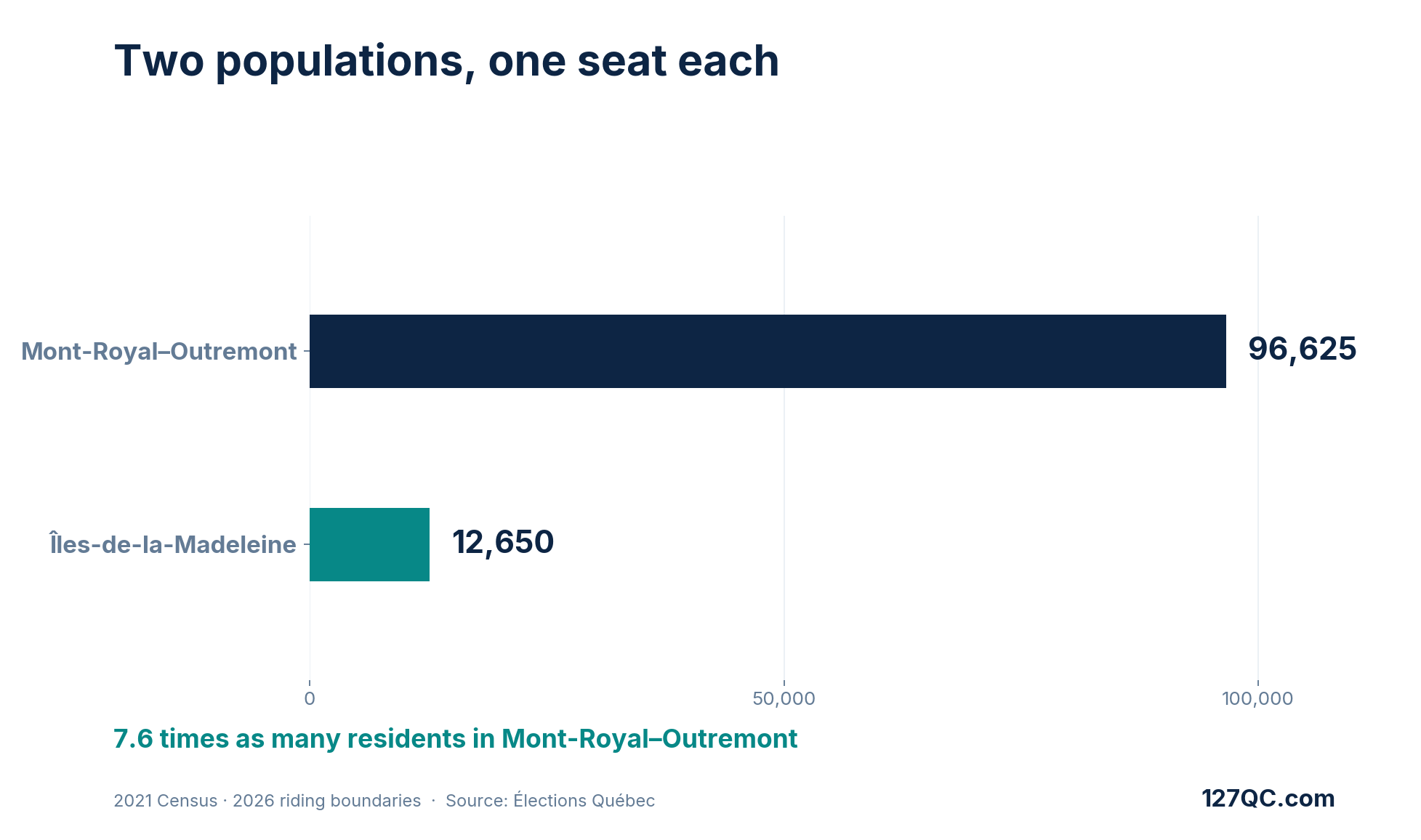
According to the 2021 Census, mapped to Quebec's 2026 electoral boundaries, Îles-de-la-Madeleine has 12,650 residents while Mont-Royal–Outremont has 96,625. These are census figures for 2021, not estimates of their current populations.
Mont-Royal–Outremont therefore has 7.6 times as many residents, yet each riding elects one MNA — just like the province's other 125 ridings.
Why does this happen? We first need to distinguish between residents and registered electors.
What the 2026 law changed
The Act to Ensure Effective Representation of Electors (2026, chapter 15), enacted on June 12, 2026, increased the provincial electoral map from 125 to 127 ridings, adding Bellefeuille and Marie-Lacoste-Gérin-Lajoie.
The law also retained the 2017 boundaries for 12 ridings, rather than adopting every change originally proposed by the Commission de la représentation électorale. The eight affected Montreal ridings were Anjou–Louis-Riel, Camille-Laurin, Hochelaga-Maisonneuve, LaFontaine, Laurier-Dorion, Pointe-aux-Trembles, Sainte-Marie–Saint-Jacques, and Viau. The four in the Gaspésie–Bas-Saint-Laurent area were Bonaventure, Gaspé, Matane-Matapédia-Mitis, and Rimouski.
Mont-Royal–Outremont is not among these 12 ridings. Preserving those older boundaries is therefore not what explains the population difference between the two ridings highlighted here.
Gaspé, one of the 12 ridings with preserved boundaries, is the second least populated, with 35,955 residents in the 2021-based riding data. The issue of uneven representation extends beyond Îles-de-la-Madeleine.
Source: Élections Québec — History of the Quebec electoral map.
Residents and electors are not the same thing
A riding's population includes everyone who lives there, including children and people who do not hold Canadian citizenship. Registered electors are people listed on the electoral roll. It is the number of registered electors, rather than all residents, that guides the drawing of riding boundaries.
| Measure | Îles-de-la-Madeleine | Mont-Royal–Outremont |
|---|---|---|
| Residents — 2021 Census | 12,650 | 96,625 |
| Registered electors — October 31, 2026 | 11,146 | 58,937 |
| Seats in the National Assembly | 1 | 1 |
Measured by registered electors, the difference is smaller: Mont-Royal–Outremont has 5.3 times as many electors per MNA. Every elector still has one ballot. The ratio describes how many people share a seat, not the probability that any one ballot changes the result.
The population and elector counts also refer to different years. Subtracting the 2026 elector count from the 2021 resident count would not tell us how many people are ineligible to vote.
The usual rule concerns registered electors
As a general rule, a riding's electorate should not differ by more than 25% from the provincial average. For example, if the average were 50,000 electors, the usual range would be 37,500 to 62,500.
As of October 31, 2026, Mont-Royal–Outremont was 15.3% above the provincial average, within that range. Îles-de-la-Madeleine was 78.2% below the average, but it benefits from a specific legal exception: the electoral commission cannot change its boundaries.
Other exceptions may be justified by territory, access, and the needs of local communities. This is the concept of effective representation: ensuring that people can be meaningfully represented, taking account of where they live.
The extremes are not the whole picture
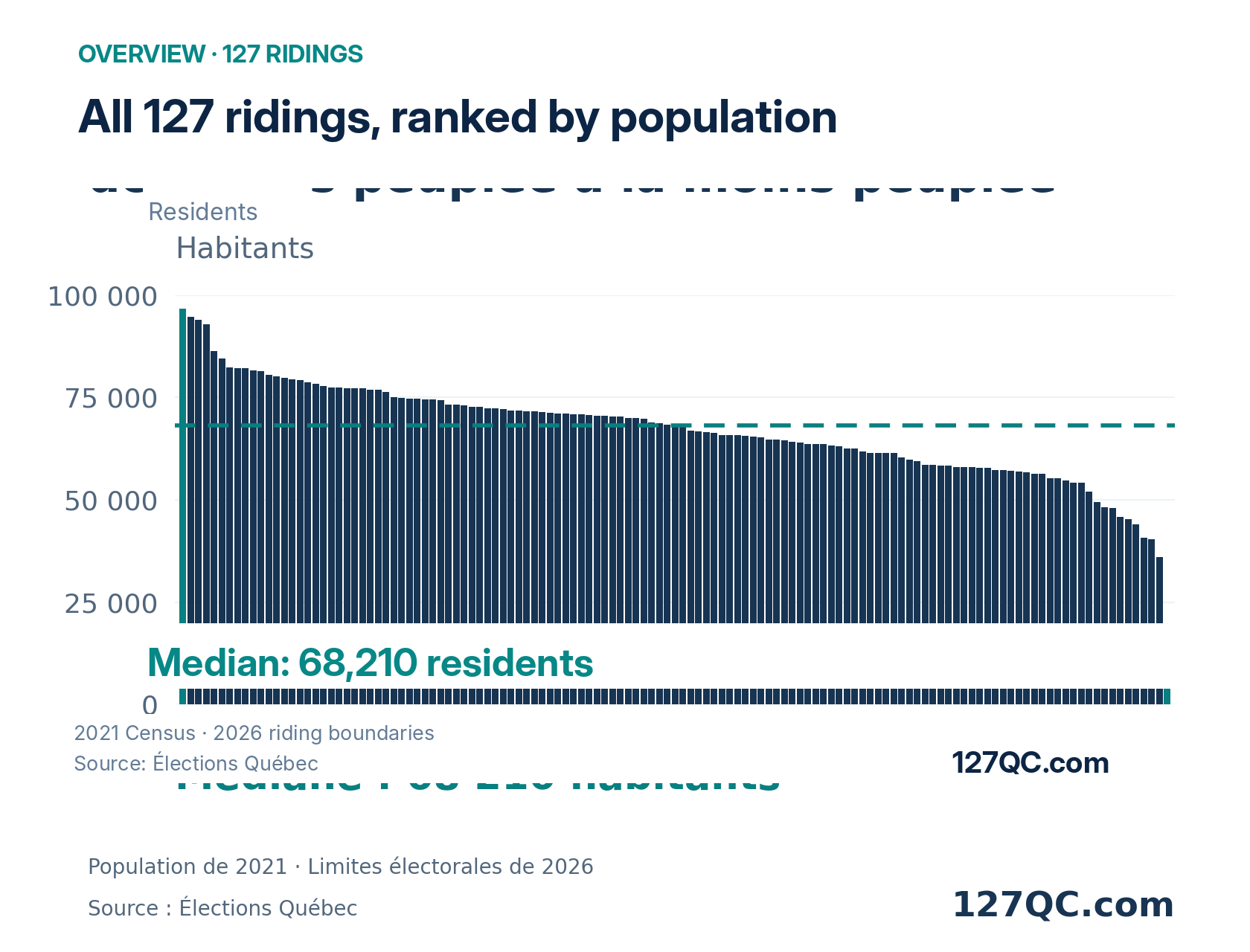
Comparing the two most extreme ridings catches the eye, but does not describe all 127 ridings. The median population — the middle value when the ridings are ranked — is 68,210 residents, in Maurice-Richard. There are 63 ridings above that number and 63 below it.
One-fifth of the residents, one-quarter of the seats
The 32 least populated ridings together contain 19.5% of Quebec's residents, yet they hold 25.2% of National Assembly seats. In other words, about one-fifth of the population is represented by one-quarter of the MNAs.
Conversely, the other 95 ridings contain 80.5% of residents but hold only 74.8% of seats.
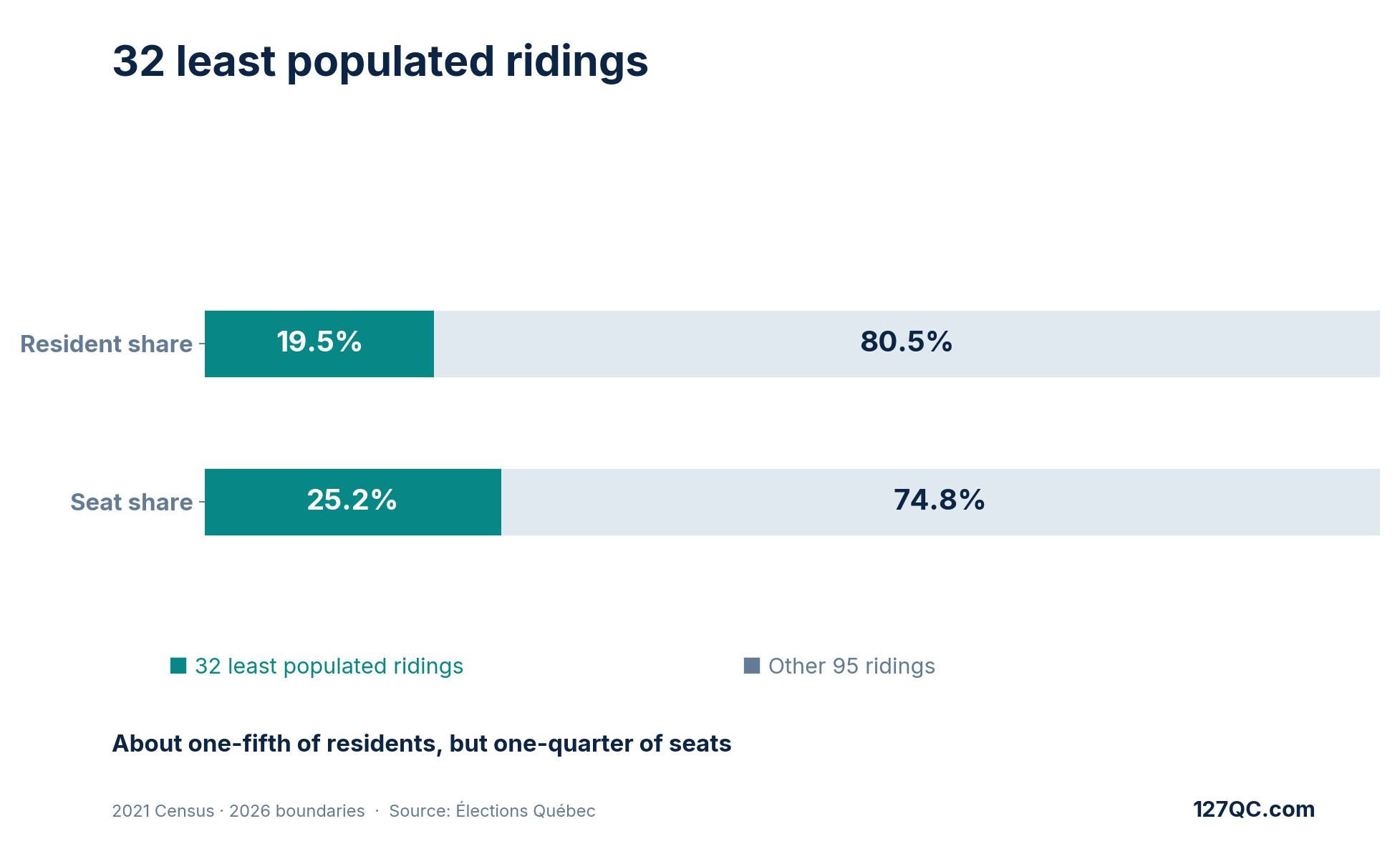
Why use 32 and 95? Ranking ridings from most to least populated, the cumulative count crosses 80% of the provincial population at the 95th riding. This is an illustration, not a legal seat-allocation rule. Nor does it measure compliance with the 25% rule, which refers to registered electors.
Protecting a community — but how far should the exception go?
An MNA does more than vote on laws: they represent a territory and help residents bring local concerns to the National Assembly. Island communities may face distinctive challenges in transportation, access to services, and supply chains.
A separate seat ensures that the residents of Îles-de-la-Madeleine elect someone specifically tasked with representing those issues. Without that protection, they might have to share an MNA with a much larger population elsewhere.
There is another side to this choice. In a more populous riding, more residents share one representative. Protecting smaller communities gives them a greater share of seats relative to their share of residents. This affects the numerical equality of representation.
Would proportional representation solve this?
Not automatically. Proportional representation aims to bring a party's share of seats closer to its share of votes. The question here is different: how many people does one locally elected MNA represent in a particular territory?
A mixed system might retain local MNAs and add seats to better reflect party vote totals. Territorial exceptions could still remain. The debate is therefore about both the voting system and the way ridings are drawn.
The real choice: which differences are acceptable?
The data reveal a trade-off. More equal elector counts per MNA improve numerical equality; keeping some exceptions protects communities with distinctive needs.
The question is how large a difference should be accepted, for which communities, and under what criteria? A well-informed debate begins by using the right measures, stating their dates, and explaining the exceptions.
Frequently asked questions
Why not merge the smallest ridings?
A merger could reduce differences in elector counts, but also create a much larger territory and join communities with different needs. Distances, accessibility, and access to an MNA matter. Quebec law specifically protects a separate riding for Îles-de-la-Madeleine.
Is my vote worth less in a larger riding?
Every elector gets one ballot. But in a riding with more registered electors, more people share one MNA. This difference in representation does not measure the odds that an individual vote changes the outcome.
Why distinguish residents from registered electors?
Residents include children and non-citizens. The rules for drawing electoral boundaries focus instead on registered electors. The most populous riding is therefore not necessarily the one with the largest electorate.
Would proportional representation fix everything?
No. It can help align party seat shares with their vote shares, but does not guarantee that every local MNA represents the same number of people. That also depends on boundary rules and territorial exceptions.
Data and sources
Population figures come from the 2021 Census, distributed across Quebec's 127 ridings under the 2026 electoral boundaries. The riding-level total of 8,501,842 residents differs by nine people from the province-wide total of 8,501,833, because census counts were allocated and rounded separately for each riding.
Registered elector counts and deviations from the average are from Élections Québec's official October 31, 2026 table. These are post-election figures, not the number registered on election day (October 5). Ratios and percentages are rounded to one decimal place.
- Élections Québec — 2021 Census statistics for the 2026 electoral map (XLS)
- Élections Québec — Riding-by-riding elector counts, updated October 31, 2026
- Élections Québec — Download the official elector counts (XLSX)
- Élections Québec — History of the 2026 electoral map and the 12 preserved boundaries
- Élections Québec — Principles of effective representation and boundary drawing
Text and charts: 127QC.com.