Who are the 127 members elected in 2026?
Three members in four are sitting for the first time, women make up 44% of the Assembly, and each party has its own regions. A portrait of the 44th legislature.
A largely new Assembly
The October 5 election changed the face of the National Assembly. Of 127 members, 93 had never sat there before.[1] The Coalition Avenir Québec, in power since 2018, elected no one, and its leader, Christine Fréchette, lost in Trois-Rivières.
Turnover varies a lot by party:
- Parti Québécois: 50 of its 60 members are new. Five were re-elected and five former members are returning.
- Quebec Liberal Party: the most experienced caucus, with 17 re-elected out of 39.
- Conservative Party of Quebec: 17 new out of 19, one re-elected and one returning.
- Québec solidaire: 5 re-elected and 4 new out of 9.
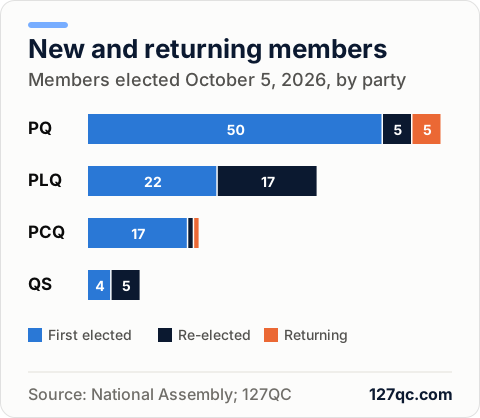
Six former members are returning: Elsie Lefebvre (Berthier), Méganne Perry Mélançon (Gaspé), Nicolas Marceau (Marie-Victorin), Nicolas Girard (Repentigny) and Alain Therrien (Sanguinet) for the PQ, and Caroline Simard (Charlevoix–Côte-de-Beaupré) for the PCQ.
Such turnover has a practical consequence: many members, including ministers, are learning parliamentary work and the rules of minority government at the same time.
Close to parity
The Assembly has 56 women and 71 men. At 44% women, it remains below parity, but the gap between parties is modest: from 37% among Conservatives to 47% among PQ members.
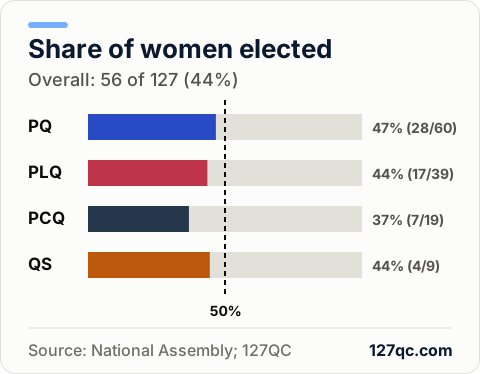
The cabinet sworn in on October 21 has 9 women out of 23 members, or 39%.[2] The full list is on our Government page.
The leaders in the Assembly
The leaders of all four parties represented were elected:
- Paul St-Pierre Plamondon (PQ), premier, in Camille-Laurin;
- Charles Milliard (PLQ), leader of the official opposition, in Orford;
- Éric Duhaime (PCQ), in Bellechasse;
- Ruba Ghazal and Sol Zanetti, Québec solidaire co-spokespersons, in Mercier and Jean-Lesage.
A strongly regional map
The 127 ridings tell four different political stories. Using the regions defined by 127QC:[3]
- The PQ dominates the regions and the north shore of Montreal: it won every seat in the Laurentides and Lanaudière (18), Bas-Saint-Laurent, Gaspésie and the Islands (6), Saguenay–Lac-Saint-Jean (5), Abitibi-Témiscamingue (3), Côte-Nord (2) and Nord-du-Québec (1). It also took 13 of the 20 seats in Montérégie.
- The PLQ holds Montreal and Laval: 19 of the 27 seats on the island of Montreal, all 6 seats in Laval and 4 of the 5 seats in the Outaouais.
- The PCQ dominates around Quebec City: all 7 seats in Chaudière-Appalaches and 8 of the 11 seats in the Capitale-Nationale.
- Québec solidaire is concentrated in cities: 6 seats in Montreal, 2 in Quebec City and 1 in Sherbrooke.
The PQ, the largest party in the Assembly, elected only 2 members on the island of Montreal. Conversely, the PLQ has no member east of the Capitale-Nationale.
Find your member
To see who represents you, check the list of the 127 elected members, which you can filter by party and region, or enter your postal code in Find my riding. Each riding page gives the member’s contact details, the October 5 results and a population profile.
Sources
- National Assembly of Québec, Members: pages and biographies of the members of the 44th legislature. Members, status (first election, re-election or return) and gender compiled by 127QC; data on the elected members page. Accessed October 21, 2026.
- TVA Nouvelles (October 21, 2026), Voici la liste des ministres du gouvernement St-Pierre Plamondon (in French).
- Élections Québec, official results of the October 5, 2026 election, count of October 8, 2026, and result of the Vachon judicial recount (October 21, 2026). Grouping of ridings by region: 127QC.