Minority government: who could bring down the PQ?
With 60 of 127 seats, the Parti Québécois governs without a majority. Yet the vote count shows that no opposition party can defeat it alone: all three would have to vote together.
The starting point: 60 out of 127
Paul St-Pierre Plamondon’s government was sworn in on October 21, 2026. It rests on the 60 members elected for the Parti Québécois, including the member for Vachon, confirmed by a judicial recount. Facing it are 39 Liberals, 19 Conservatives and 9 Québec solidaire members.[1]
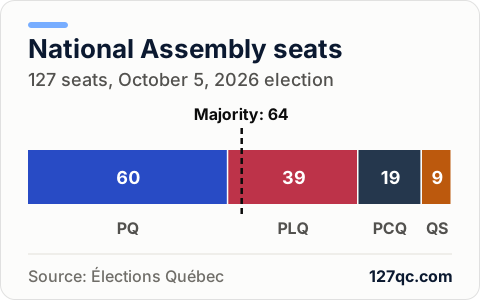
Being in a minority does not mean losing every vote. It means that on every important vote, the government needs at least part of the opposition not to vote against it.
The math: which opposition parties could win?
If every member is present and votes, here is how the possible combinations compare with the government’s 60 votes:
- PLQ + PCQ + QS: 67 votes. The only combination that outnumbers the government.
- PLQ + PCQ: 58 votes. Two fewer than the PQ.
- PLQ + QS: 48 votes, and PCQ + QS: 28 votes. Far short.
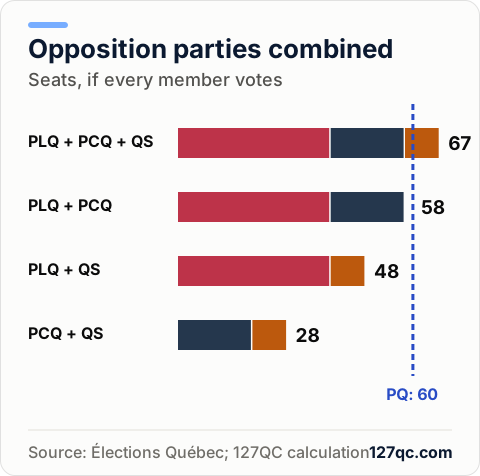
In other words, Québec solidaire’s 9 members cannot bring down the government on their own, but no defeat is possible without them. If just one of the three opposition parties supports the government or abstains, the government survives.
Two caveats. First, the presidency of the National Assembly (the Speaker), still vacant on October 21, in principle takes one vote away from the side it comes from: under British-style parliamentary tradition, the presiding member votes only to break a tie. If the Speaker comes from the PQ, the government has 59 votes, still one more than the Liberals and Conservatives combined. If the Speaker comes from the opposition, the opposition loses a vote. The conclusion holds either way. Second, absences matter: a close vote can turn on two or three missing members.
Which votes can bring the government down?
Not every vote puts the government at risk. The Standing Orders of the National Assembly limit questions of confidence to five situations:[2]
- a motion of censure, which must clearly state that the Assembly withdraws its confidence in the government;
- the motion approving the government’s general policy, after the opening speech;
- the motion approving its budget policy, after the budget speech;
- the passage of a supply bill, which authorizes spending;
- any motion on which the government has expressly staked its responsibility.
Opposition parties may move up to seven motions of censure per session.[2] Outside these cases, the government can lose a vote, on an ordinary bill for instance, without having to resign.
The first test will come with the opening speech of the new legislature and the vote on the government’s general policy that follows it.
What the precedents show
Quebec has had three minority governments before this one:
- 1878–1879. Henri-Gustave Joly de Lotbinière’s Liberals, with 31 seats to the Conservatives’ 32, governed thanks to two independent Conservatives. Defections returned the Conservatives to power in 1879.[3]
- 2007–2008. Jean Charest’s Liberals won 48 of 125 seats, the first minority government since 1878.[4] Without losing a confidence vote, Charest called an election on November 5, 2008, and won a majority on December 8.[5]
- 2012–2014. Pauline Marois’s Parti Québécois formed a government with 54 members. It called an election itself on March 5, 2014, and lost it on April 7.[6]
In both recent cases, the minority government ended by the premier’s decision, not by a lost vote in the Assembly. There is no guarantee things will go the same way this time. We explain the rules that govern the date of the next election in When is Quebec’s next election?
What it changes in practice
A minority government has to negotiate. To pass its budget or major bills, the PQ will need the support, or at least the abstention, of one of the three opposition parties. Each opposition party, in turn, will have to decide vote by vote whether it would rather win concessions or risk an early election.
To see who represents your riding, check the list of the 127 elected members or find your riding by postal code.
Sources
- Le Droit (October 21, 2026), Voici les ministres du gouvernement du Parti québécois (in French): swearing-in, minority government, presidency of the Assembly still undecided. Seats: Élections Québec results, see the elected members on 127QC.
- Assemblée parlementaire de la Francophonie, Recueil des procédures parlementaires: Québec, chapter 8 (in French), based on the Standing Orders of the National Assembly, sections 303.1, 304 and 304.1. Accessed October 22, 2026.
- Wikipedia, Élections générales québécoises de 1878 (in French). Accessed October 22, 2026.
- Wikipedia, 2007 Quebec general election. Accessed October 22, 2026.
- Wikipedia, Élections générales québécoises de 2008 (in French). Accessed October 22, 2026.
- Wikipedia, Élections générales québécoises de 2014 (in French). Accessed October 22, 2026.